
Menu

Encore launches Marketing First Aid and regional media took notice

When markets shift fast, most businesses face the same dilemma: keep spending without a clear plan, or go quiet and risk losing visibility. Encore built a service specifically to break that pattern — and the response from regional media confirmed that the timing was right.

What is Marketing First Aid

Marketing First Aid is a rapid strategic intervention designed for businesses that need clarity fast. Not another lengthy strategy project. Not a generic audit template. A focused, senior-level review that delivers a concrete action plan within 3–5 days.

During that window, Encore’s team reviews a company’s current marketing activities across all critical dimensions: digital presence, customer acquisition channels, brand messaging and positioning, competitor activity, and opportunities to strengthen visibility and demand. The review also assesses whether the company’s marketing infrastructure can support scalable campaigns — and identifies the main gaps holding growth back.

At the end of the process, the client receives clear recommendations, a short-term action plan, and a strategy call with the Encore team.

“In periods like this, the most expensive mistake is to stop communicating or keep spending without clarity,” said Eugenia Kinder, Founder of Encore. “Businesses do not need more noise right now. They need a fast, honest view of what is actually happening in their marketing and what steps will help them protect visibility, demand, and trust.”

The idea came directly from Encore’s own project experience. Over recent years, the agency worked with brands and cultural platforms that had to stay visible and commercially strong in fast-moving regional markets — including ARTDOM Riyadh, Moscow Film Cluster × Red Sea International Film Festival, TUD TOY in Dubai, and HiFi Hi-End Show in the UAE. One pattern kept repeating: under pressure, businesses rarely needed a new strategy. They needed someone to quickly identify what was already working, what was leaking demand, and what had to change first.

“Many businesses are under pressure to act quickly, but they do not always have the time or internal structure to stop, diagnose the problem, and reset their priorities,” said Karina Usakovskaya, Founder and Marketing Strategist at Encore. “This format is designed to give them that clarity fast.”

How regional media covered the launch

The launch was picked up by several key business and trade publications across the Middle East — outlets that reach the exact audience Marketing First Aid was built for.

Zawya — one of the most recognised business news portals in the region with a reach of 488,000 — covered the initiative as part of its ongoing focus on business strategy and market conditions in the Middle East.

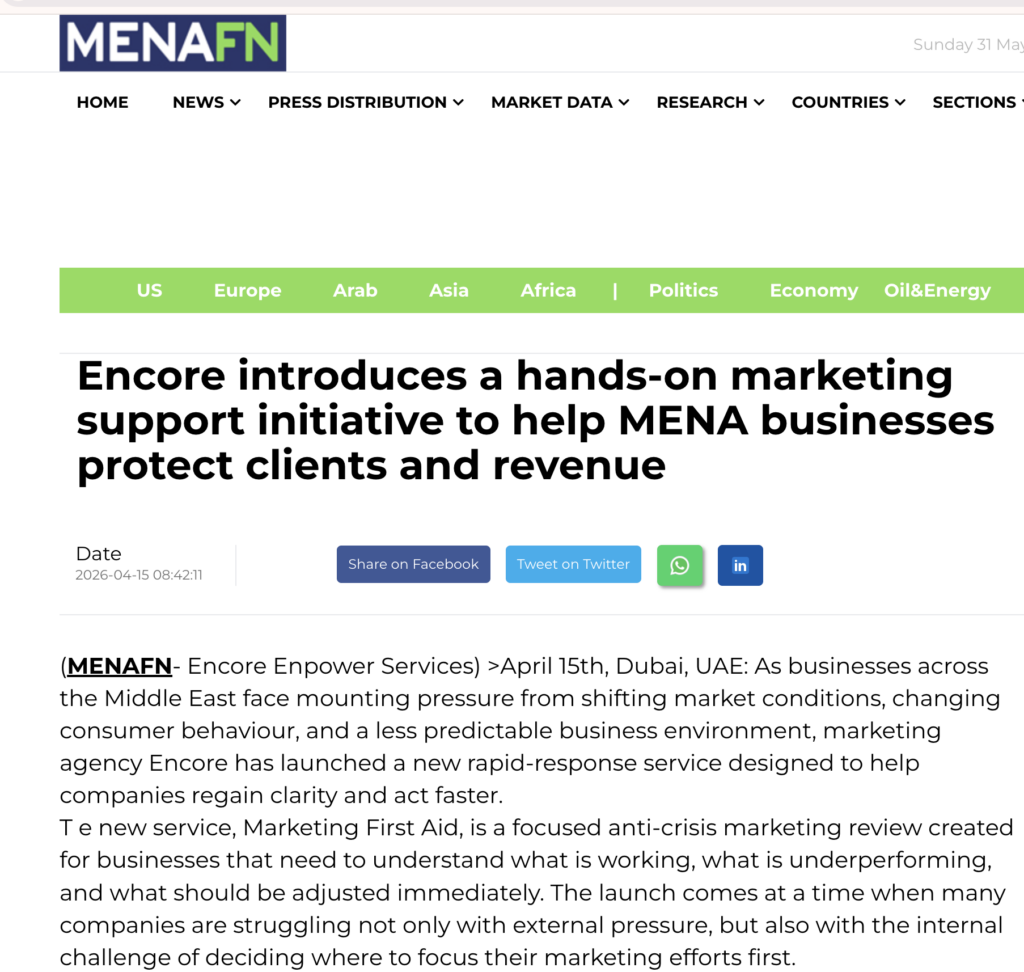
MENA-FN, another leading trade and business news platform with 254,000 readers, published the story highlighting Encore’s positioning and the quote from Eugenia Kinder on the cost of marketing silence during uncertain periods.
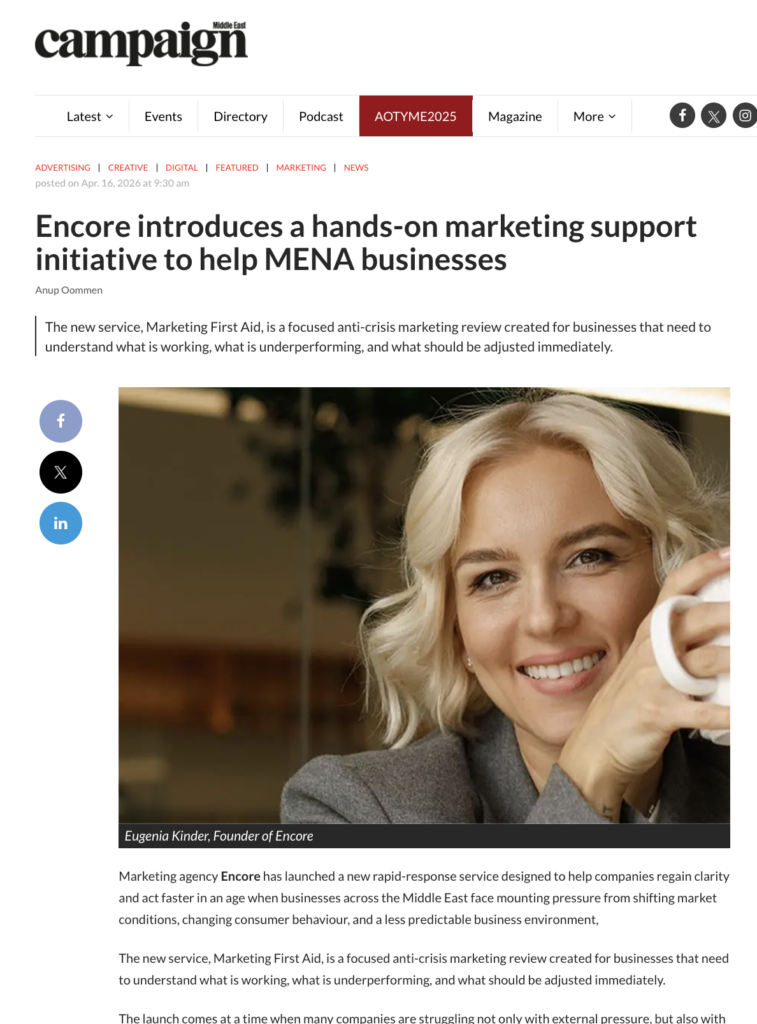
Campaign Middle East — the region’s top publication for the PR and communications industry, with a print circulation and active social presence — featured the story in its digital coverage. A print mention in the May issue is also expected.
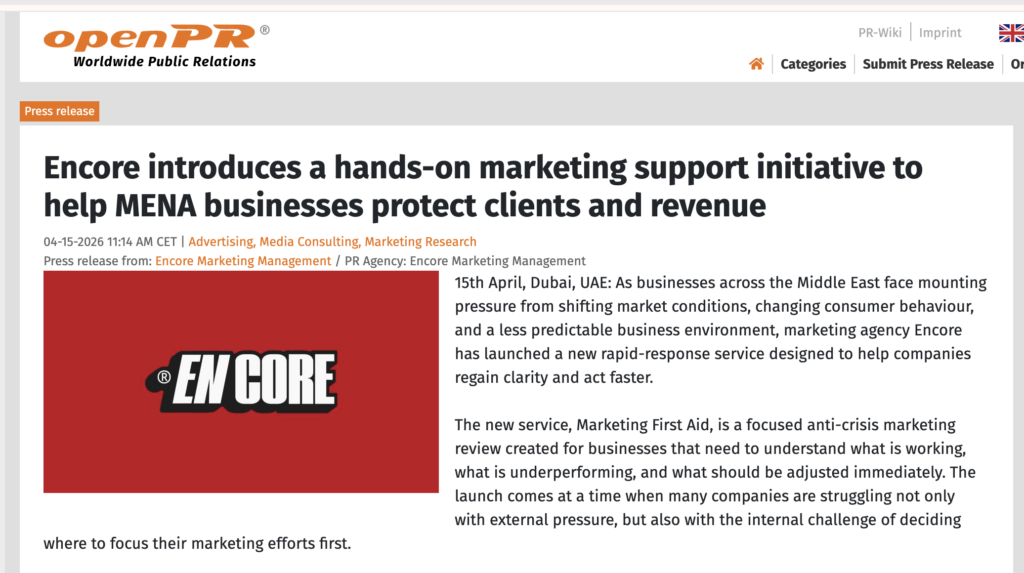
Open PR (430,000 reach) and Middle East News 24/7 rounded out the coverage, extending the story’s reach to both global and GCC-specific audiences.
Combined, the launch reached over 1.3 million readers across Tier 1 and Tier 2 business media in the region.

Why it matters

For businesses operating in the UAE, Saudi Arabia, and across the MENA region, the timing of Marketing First Aid reflects something real: market conditions in 2025–2026 have made it harder to plan with confidence, and many companies are genuinely unsure where their marketing efforts are performing and where they are not.

“Strong brands do not disappear in difficult moments,” said Eugenia Kinder. “They adapt faster, communicate better, and stay visible in ways that feel relevant and trustworthy. That is exactly what this service is meant to support.”

How businesses should approach marketing during uncertainty in the Middle East

When the market becomes less predictable, many businesses instinctively reduce activity. Marketing budgets are frozen, campaigns are postponed, and communication becomes осторожной or inconsistent.

At first glance, this feels logical. If the environment is changing quickly, it may seem safer to wait.
In reality, this is often the exact moment when marketing matters most.

Periods of uncertainty do not remove the need for communication. They change the way brands should communicate. Businesses that continue to market thoughtfully, adjust quickly, and stay relevant to the moment are often the ones that retain trust, protect visibility, and stay top of mind while others disappear.

The key is not to stop marketing. The key is to adjust it.

1. Adjust the tone of your marketing

In periods of regional tension, audiences read brand communication differently. Messages that may have felt strong or energetic before can suddenly feel too aggressive, disconnected, or out of touch.

This does not mean brands need to go silent. It means they need to become more precise in how they speak.

A more effective approach is to:

  • shift from hard sales messaging to value, expertise, and reassurance
  • replace loud, overly promotional creatives with calmer, trust-building visuals
  • focus communication on the solutions your business provides and the stability you can offer clients

When the external environment feels uncertain, audiences naturally look for signals of reliability. Brands that communicate with more thought, clarity, and restraint are often perceived as more stable and more credible.

2. Shorten your planning cycles

Long-term marketing plans become harder to manage when the situation around you changes quickly. A campaign that looked timely a month ago may no longer fit the mood of the market today.

This is why shorter planning cycles become far more effective during uncertain periods.

Instead of building rigid campaigns too far in advance, businesses should:

  • plan in shorter windows, such as three to four weeks
  • review campaign performance more frequently
  • adjust budgets, creatives, and messaging based on real-time results

This does not make marketing chaotic. On the contrary, it makes it more controlled. Shorter planning cycles allow brands to stay responsive without losing direction.

3. Shift attention toward channels you can control

During uncertain periods, paid advertising can become less predictable. News cycles change quickly, public sentiment shifts, and some placements may suddenly feel inappropriate or ineffective.

That is why businesses should strengthen the channels they control directly.

These usually include:

  • social media accounts and owned content
  • direct communication with existing audiences
  • PR and earned media
  • email, messaging, and other forms of direct reach

The advantage of these channels is flexibility. They allow businesses to adjust messaging quickly, react to changes in tone, and stay relevant without relying entirely on paid media conditions.

Paid campaigns can still play an important role, but during uncertainty they work best as part of a broader, more resilient communication mix.

4. Monitor the news cycle before launching campaigns

In the Middle East, public sentiment can shift quickly depending on political, economic, or regional developments. That makes timing especially important.

Before launching or scaling any campaign, brands should assess:

  • the current news agenda
  • whether the message may feel insensitive in the context of what is happening
  • whether the timing is still right for the campaign as planned

This step is often overlooked, but it can protect both performance and reputation.

A campaign that ignores the wider context may not only underperform — it may damage trust. On the other hand, brands that stay aware of the moment are more likely to communicate with relevance and care.

5. Uncertainty is not a reason to disappear

One of the biggest mistakes businesses make during difficult periods is assuming that silence is safer than action.

In reality, silence often creates a different kind of risk: loss of visibility, weaker market presence, and reduced trust. While one brand pauses, another adjusts and keeps moving.

This is why uncertainty should not lead to total withdrawal. It should lead to sharper strategy.

Businesses do not need louder campaigns in moments like this. They need more awareness, more flexibility, and better judgment. They need communication that reflects the current reality without losing commercial focus.

Final thought

Marketing during uncertainty is not about pretending nothing is happening. It is about responding to reality with more intelligence.

The brands that navigate difficult periods best are usually not the ones with the biggest budgets or the loudest campaigns. They are the ones that stay alert, adapt quickly, and communicate with clarity.

When the market changes, thoughtful marketing becomes a business advantage.

Search